
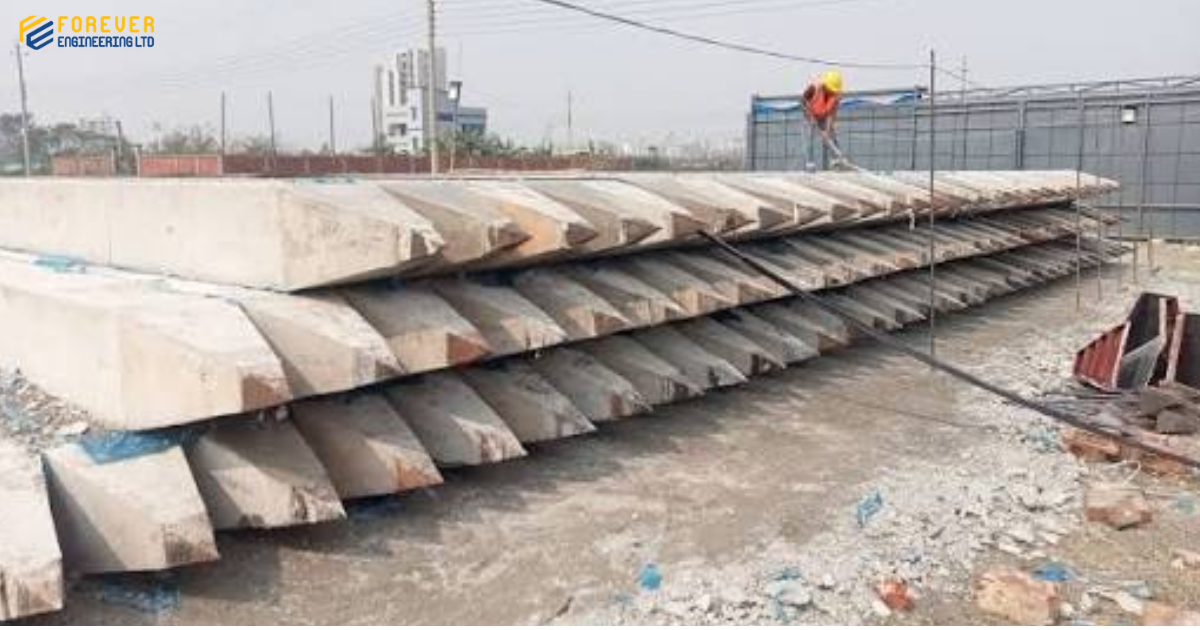
What is the load carrying capacity of a precast pile?
How Much Load Can a Precast Pile Carry? The load carrying capacity of a pile is the amount of weight it can safely support without failure. Engineers calculate this before construction begins. A precast pile transfers the weight of a building, bridge, factory, or other structure from weak soil to stronger soil layers deep underground.
Precast piles are widely used in Bangladesh because many areas have soft soil conditions. A strong foundation is essential to keep buildings stable and safe. The load carrying capacity of a precast pile depends on several factors, including pile size, soil condition, pile length, concrete strength, and installation quality. A larger pile can usually carry more load than a smaller pile. Soil conditions also play an important role in determining pile performance. A properly installed pile with high-quality concrete will provide better strength and durability.
Different precast piles can carry different amounts of weight. Smaller piles may support residential buildings, while larger piles can support factories, bridges, and high-rise structures. Understanding how much load a precast pile can carry helps engineers choose the right foundation solution for each project.
Why is load-carrying capacity
The foundation holds up the building. If the pile can’t carry the needed load, the building might sink unevenly. Have structural issues.
The benefits of getting the load capacity right are the following:
- The structure is safer
- You get a foundation to support the building
- The building does not sink much
- The load is distributed better
- The building lasts for a time
- You have to spend money on maintenance

What factors affect how much weight a precast pile can carry?
Several things influence how much load a precast pile can handle.
1. Pile Size
A larger precast pile can carry weight than a smaller precast pile. This is because a bigger precast pile is stronger and can transfer weight to the soil around it.
Some benefits of using piles are the following:
- Precast piles can carry a load
- They make the structure more stable
- They make the foundation stronger
- Precast piles are suitable for structures like high-rise buildings
2. Soil Condition
The condition of the soil around the precast pile greatly affects how well the pile works. Strong soil layers can support a load, while soft soil may reduce the load-carrying capacity. Engineers do soil tests before designing the foundation to find the pile solution.
Some benefits of investigating the soil are the following:
- pile design
- Better safety
- This improved foundation performance
- Reduced construction risks
3. Pile Length
When you have a pile, it goes deeper into the earth and reaches the stronger soil layers. This is a thing. A longer pile often provides support, increased load capacity, stability, and reduced settlement. The length of the pile that you need depends on the site conditions. What the project needs.
4. Concrete Strength
The quality of the concrete is very important because it affects how well it works. High-quality concrete provides durability, higher compressive strength, a longer service life, and improved load-carrying ability. Manufacturers use production methods to make sure the concrete is strong enough.
5. Reinforcement Design
The steel reinforcement inside the pile helps it resist loads and stresses. This is important because it gives the pile structural strength, improved crack resistance, better durability, and increased safety. You need to design the reinforcement so that the foundation works well.
Typical load-carrying capacity of precast piles
The load capacity varies depending on design and site conditions. The following values provide a general idea.
250 mm × 250 mm Precast Pile
This size is often used for small to medium construction projects. Typical capacity:
- Approximately 30 to 50 tons
Common applications:
- Small buildings
- Residential projects
- Light commercial structures
300 mm × 300 mm Precast Pile
This is one of the most commonly used pile sizes in Bangladesh. Typical capacity:
- Approximately 50 to 80 tons
Common applications:
- Apartment buildings
- Commercial buildings
- Medium-sized factories
350 mm × 350 mm Precast Pile
This pile can support heavier loads. Typical capacity:
- Approximately 80 to 120 tons
Common applications:
- Large commercial projects
- Industrial facilities
- Multi-story buildings
400 mm × 400 mm Precast Pile
This size is suitable for heavy construction projects. Typical capacity:
- Approximately 120 to 180 tons or more
Common applications:
- High-rise buildings
- Bridges
- Large factories
- Infrastructure projects
The actual load capacity depends on engineering design and soil conditions.
How do engineers determine pile load capacity?
Engineers use several methods to calculate the safe load carrying capacity of precast piles.
Soil Investigation
Engineers first conduct soil tests to understand the ground conditions.
The soil investigation helps determine:
- Soil strength
- Soil layers
- Groundwater level
- Foundation requirements
This information forms the basis of foundation design.
Engineering Calculations
Engineers use standard formulas and design codes to calculate pile capacity.
These calculations consider:
- Soil resistance
- Pile dimensions
- Concrete strength
- Structural load
Proper calculations help ensure safe foundation performance.
Pile Load Testing
Load testing is one of the most reliable methods for verifying pile capacity.
During the test, engineers apply load to the pile and monitor its performance.
Benefits of load testing:
- Accurate results
- Improved safety
- Verification of design assumptions
- Reduced construction risks
Many major projects perform pile load tests before full-scale construction.

What types of loads act on a precast pile?
Precast piles must support different types of loads during their service life.
Dead Load
Dead load refers to the permanent weight of the structure.
Examples include:
- Walls
- Floors
- Roofs
- Columns
- Beams
Live Load
A live load includes movable or temporary loads.
Examples include:
- People
- Furniture
- Equipment
- Vehicles
Wind Load
Tall buildings must resist wind forces.
The pile foundation helps transfer these forces safely into the ground.
Seismic Load
In some regions, foundations must also resist earthquake forces.
Strong pile foundations improve structural stability during seismic events.
Why do engineers prefer precast piles for heavy loads?
Precast piles offer several advantages when supporting heavy structures.
Advantages include:
- High load carrying capacity
- Consistent manufacturing quality
- Strong concrete strength
- Quick installation
- Long service life
- Reliable performance
These benefits make precast piles a popular choice for foundation construction.
Which projects require high-load-carrying precast piles?
Many construction projects require piles with high load capacity.
Residential Buildings
Large apartment complexes often use precast piles to support building loads safely.
Commercial Buildings
Shopping malls, hotels, office towers, and commercial complexes require strong foundations.
Industrial Projects
Factories and warehouses contain heavy machinery and equipment that create large foundation loads.
Bridge Construction
Bridge foundations often require piles capable of supporting very high loads.
Infrastructure Projects
Roads, flyovers, power plants, railway projects, and utility structures frequently use precast piles.
Marine Structures
Ports, jetties, and waterfront developments often rely on precast piles because of their strength and durability.
How does proper pile selection improve foundation performance?
Choosing the correct pile size and capacity is important for project success.
Benefits include:
- Better structural stability
- Reduced foundation settlement
- Improved safety
- Longer service life
- Lower maintenance costs
- Better project performance
Engineers carefully evaluate project requirements before selecting the pile type and size.
Why is quality manufacturing important for load capacity?
The load-carrying ability of a pile depends greatly on manufacturing quality.
Factory production allows manufacturers to control every stage of the process.
Benefits of factory manufacturing:
- Better concrete quality
- Accurate dimensions
- Consistent strength
- Proper curing
- Improved durability
- Reliable performance
Quality control inspections help ensure that each pile meets engineering standards before delivery.
Precast pile solutions in Bangladesh
Precast piles play an important role in modern construction throughout Bangladesh. Because many areas have soft soil, strong foundations are necessary for safe and durable structures.
The load carrying capacity of a precast pile depends on pile size, soil conditions, pile length, concrete strength, and reinforcement design. Small piles may carry around 30 tons, while larger piles can support more than 180 tons depending on engineering requirements.
At Forever Engineering Ltd., we manufacture high-quality precast piles for residential, commercial, industrial, bridge, and infrastructure projects. Our team works closely with engineers and contractors to provide reliable piling solutions based on soil conditions and project requirements.
We focus on producing strong, durable, and dependable precast piles that help create safe foundations across Bangladesh.
FAQ: How Much Load Can a Precast Pile Carry?
1. How much load can a precast pile carry?
The load capacity varies depending on pile size, soil condition, and design. It can range from about 30 tons to over 180 tons.
2. What affects the load carrying capacity of a precast pile?
Pile size, pile length, soil strength, concrete quality, reinforcement design, and installation methods all affect capacity.
3. Can precast piles support high-rise buildings?
Yes. Large precast piles are commonly used for high-rise buildings because they can carry heavy structural loads.
4. How do engineers determine pile capacity?
Engineers use soil investigations, engineering calculations, and pile load tests to determine safe load capacity.
5. Why are precast piles popular in Bangladesh?
They provide strong foundation support, perform well in soft soil, offer high load capacity, and have a long service life.
6. Which pile size carries the highest load?
Generally, larger piles, such as 400 mm × 400 mm piles, can carry higher loads than smaller pile sizes, depending on soil conditions and design.