
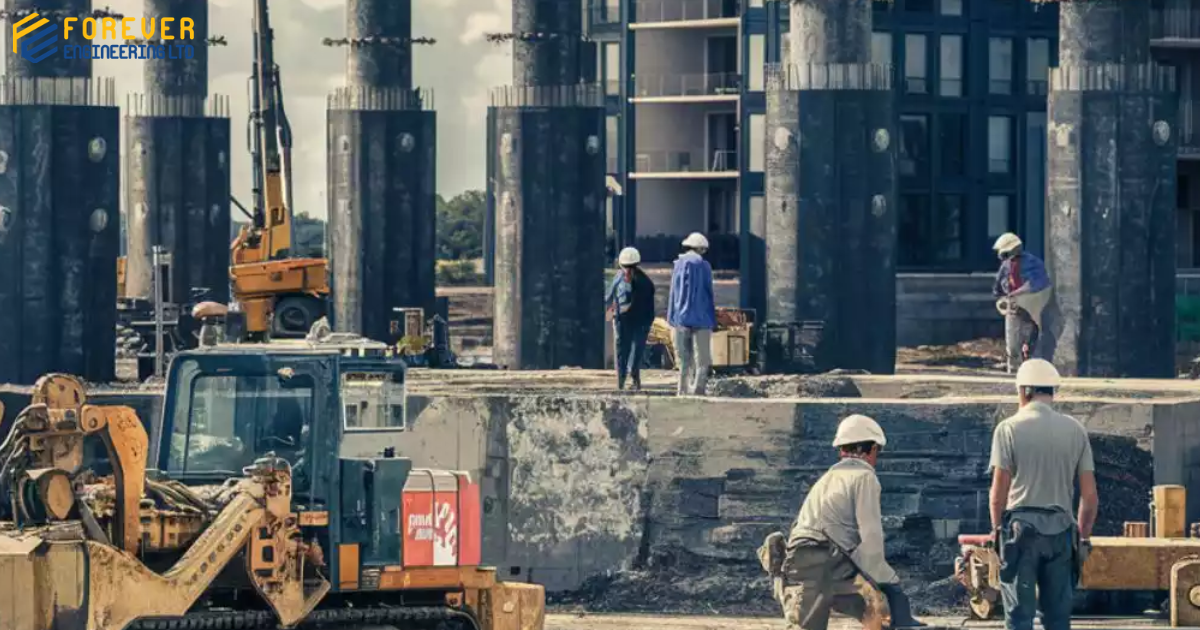
A Cast in Situ Pile Contractor plays an important role in foundation construction where deep and strong foundations are required. Cast in situ piles are constructed directly inside the ground by drilling or boring a hole, placing reinforcement, and filling the hole with concrete. This method can provide strong foundation support for buildings, bridges, industrial structures, and large construction projects.
Choosing an experienced contractor is important because cast in situ pile construction requires proper site investigation, drilling equipment, reinforcement work, concrete placement, testing, and quality control. The contractor must understand soil conditions, groundwater, pile depth, pile diameter, structural requirements, and site limitations before starting the work.
Forever Engineering Ltd. provides piling and foundation solutions for construction projects in Bangladesh. The company can support project owners, contractors, developers, and consultants with piling requirements, project planning, technical guidance, and foundation-related services.

What Is a Cast in Situ Pile?
A cast in situ pile is a deep foundation constructed at the project site. Unlike precast piles, which are manufactured before delivery, cast in situ piles are formed inside a prepared borehole.
The construction normally starts with setting out the pile location and drilling the ground to the required depth. Depending on soil and groundwater conditions, temporary casing or drilling slurry may be used to keep the borehole stable. After excavation reaches the required depth, the hole is checked and cleaned before reinforcement and concrete are placed.
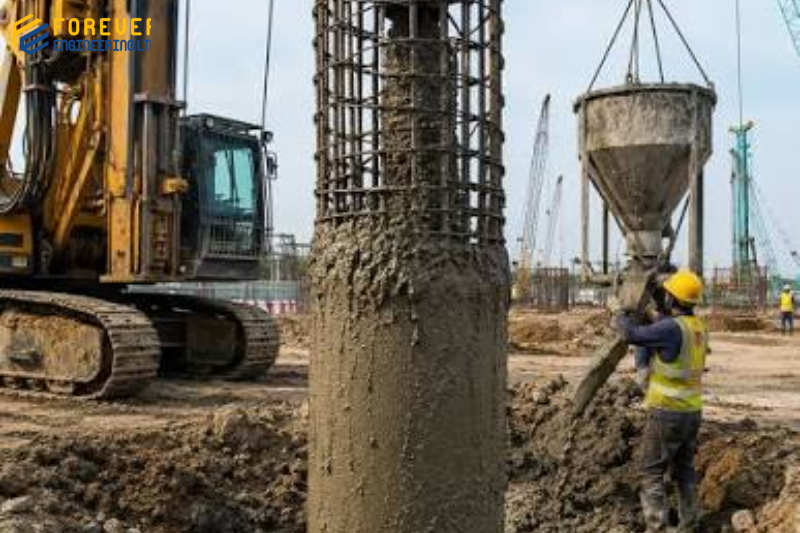
The reinforcement cage is then lowered into the borehole. Concrete is placed using a suitable method, such as direct placement in a dry borehole or tremie placement where water or slurry conditions require it. Proper construction control is important because the reinforcement cage must remain in the correct position during concreting.
Why Are Cast in Situ Piles Used in Construction?
Cast in situ piles are useful when a project requires deep foundation support and the required bearing layer is located below the ground surface. They can also be suitable for projects where low vibration is preferred compared with driven pile installation.
The pile diameter and depth can be selected according to structural loads, soil conditions, and the approved foundation design. This makes cast in situ piling suitable for many types of construction projects.
Common Benefits Include:
- Deep Foundation Support: Cast in situ piles can transfer structural loads to suitable deeper soil or rock layers.
- Flexible Pile Depth: The pile depth can be adjusted according to site investigation and foundation design.
- Large Load Capacity: Properly designed piles can support significant structural loads.
- Low Ground Vibration: Bored construction generally creates less vibration than pile driving.
- Suitable for Large Projects: The method can be used for high-rise buildings, bridges, industrial structures, and infrastructure projects.
- Flexible Diameter: Different pile diameters can be selected according to project requirements.
What Does a Cast in Situ Pile Contractor Do?
A Cast in Situ Pile Contractor manages the construction activities required to install cast in situ piles according to the approved project design.
The contractor coordinates drilling, casing or slurry operations where required, borehole cleaning, reinforcement cage installation, concrete placement, equipment operation, and quality checks. The contractor may also coordinate pile testing and maintain construction records.
Proper planning is important because piling work involves heavy equipment and must follow a planned construction sequence. Site access, working platform conditions, equipment capacity, concrete supply, reinforcement preparation, and groundwater conditions should be reviewed before production piling begins.
Cast in Situ Pile Services by Forever Engineering Ltd.
Forever Engineering Ltd. supports construction and foundation projects with piling-related services and technical solutions. The company works with project requirements to help clients plan suitable foundation construction methods.
For cast in situ piling projects, the required approach depends on pile diameter, pile depth, soil condition, groundwater level, structural load, site access, and project schedule.
Forever Engineering Ltd. can support project owners and contractors with project consultation, piling requirements, equipment planning, construction coordination, and pricing information based on project conditions.
What Factors Affect Cast in Situ Pile Construction?
Every piling project has different ground and structural conditions. A contractor should review these conditions before selecting the construction method and equipment.
- Soil Condition: Soil layers affect drilling performance, borehole stability, and pile construction requirements. Soft soil, dense sand, clay, gravel, and rock layers may require different drilling approaches.
- Groundwater: Groundwater can affect borehole stability and concrete placement. Casing or drilling slurry may be required when the excavation cannot remain stable.
- Pile Diameter: The required pile diameter depends on structural loads, soil conditions, and foundation design.
- Pile Depth: Deeper piles may require larger drilling equipment, additional casing, and more careful construction planning.
- Structural Load: The required pile capacity depends on the loads transferred from the building or structure to the foundation.
- Site Access: Large drilling rigs and cranes need enough space to enter and operate safely at the project site.
- Working Platform: The ground should provide a suitable and stable platform for heavy drilling and lifting equipment.
- Nearby Structures: Existing buildings, roads, utilities, and other structures may affect equipment movement and construction methods.
- Project Schedule: Concrete supply, reinforcement preparation, drilling speed, equipment availability, and testing can affect the overall piling schedule.
- Quality Requirements: The project specification may require specific inspection, concrete testing, pile integrity testing, load testing, and documentation.
What Equipment Is Used for Cast in Situ Pile Construction?
A Cast in Situ Pile Contractor needs suitable equipment to complete drilling, reinforcement, concrete placement, and supporting activities.
Common Equipment Includes:
- Bored Pile Drilling Rig: Used to drill the pile borehole to the required depth and diameter.
- Kelly Bar and Drilling Tools: Used with drilling rigs to excavate different types of soil.
- Temporary Casing: Used where necessary to support unstable sections of the borehole.
- Desanding or Slurry Equipment: Used when drilling slurry is required to maintain borehole stability.
- Crane: Used to lift reinforcement cages, casing sections, and other heavy components.
- Reinforcement Cage Equipment: Used to prepare and position the steel cage.
- Tremie Pipe: Used to place concrete through water or slurry without uncontrolled mixing.
- Concrete Equipment: Concrete trucks, pumps, hoppers, and related equipment may be used according to the construction method.
- Survey Equipment: Used to check pile location, alignment, and elevation.
- Testing Equipment: Used for concrete and pile quality control according to project requirements.
The equipment should match the project conditions. FHWA guidance also recommends that the equipment and tools used for drilled shaft construction meet the approved installation plan and that the correct casing, slurry equipment, tremie, and inspection procedures are available where required.
How Is Cast in Situ Pile Construction Completed?
Cast in situ pile construction follows a planned sequence. The exact method may change according to soil, groundwater, pile size, equipment, and project specifications.
- Review the Foundation Design: The contractor first reviews the approved drawings, pile diameter, pile depth, pile locations, reinforcement requirements, concrete specifications, and testing requirements.
- Prepare the Site: The working area is prepared so that drilling rigs, cranes, concrete trucks, and other equipment can operate safely.
- Set Out the Pile Location: Survey equipment is used to mark the exact position of each pile according to the foundation layout.
- Position the Drilling Rig: The drilling rig is moved to the pile location and aligned properly before drilling begins.
- Install Temporary Casing if Required: Casing may be installed through unstable soil layers to help maintain the borehole during excavation.
- Drill the Borehole: The drilling tool removes soil from the ground until the required pile depth is reached.
- Control Borehole Stability: Casing or drilling slurry may be used where soil or groundwater conditions could cause the borehole to collapse.
- Check the Borehole: The contractor checks the pile depth, diameter, verticality, and bottom condition according to the project requirements.
- Clean the Borehole: Loose soil, sediment, or unwanted material at the bottom is removed before reinforcement and concrete placement.
- Prepare the Reinforcement Cage: Reinforcement bars are assembled into a cage according to the approved structural design.
- Lower the Reinforcement Cage: The completed cage is carefully lifted and lowered into the borehole while maintaining the required position and concrete cover.
- Secure the Cage: The cage is supported so that it does not move excessively, settle, or float during concrete placement. Proper spacers help maintain the required position and cover.
- Place the Concrete: Concrete is placed using the method selected for the site condition. Tremie placement is commonly used when water or slurry is present in the borehole.
- Complete Concrete Placement: Concrete placement continues according to the approved procedure until the pile reaches the required level.
- Remove Temporary Casing: Where temporary casing is used, it is removed according to the approved construction procedure without damaging the fresh concrete.
- Finish the Pile Head: After the concrete reaches the required condition, the pile head is prepared for connection with the pile cap or other foundation element.
- Conduct Required Tests: Pile testing and concrete quality checks are performed according to the project specifications.
- Record the Construction Data: The contractor maintains records such as pile location, depth, drilling conditions, concrete quantity, reinforcement details, and testing results.
How Does a Contractor Maintain Cast in Situ Pile Quality?
Quality control starts before drilling and continues until testing and documentation are completed. The contractor should follow the approved construction method instead of changing the procedure without technical review.
Borehole location, depth, verticality, bottom cleanliness, reinforcement cage position, concrete quality, and concrete placement should be checked during construction.
The reinforcement cage should remain securely positioned during concrete placement. FHWA inspection guidance also identifies cage configuration, tying, spacers, cage support, pile location, depth, vertical alignment, borehole cleanliness, and concrete placement as important inspection items.
Important Quality Checks Include:
- Pile Location: Confirm the pile is constructed at the correct position.
- Pile Depth: Check that the pile reaches the required design depth.
- Borehole Condition: Check the borehole before reinforcement and concrete placement.
- Reinforcement Cage: Check size, configuration, length, tying, and position.
- Concrete Quality: Check the approved concrete mix and required testing.
- Concrete Placement: Monitor the placement method and sequence.
- Pile Testing: Complete required integrity or load testing.
- Construction Records: Keep proper records for each completed pile.
What Problems Can Occur During Cast in Situ Pile Construction?
Piling work can face different problems because underground conditions cannot always be predicted perfectly. Proper site investigation and experienced construction control can reduce these risks.
Borehole collapse can occur when the surrounding soil is unstable. Groundwater can also make excavation and concrete placement more difficult. Poor cleaning can leave unwanted material at the bottom of the pile.
Other problems may include reinforcement cage movement, incorrect pile location, concrete quality problems, insufficient concrete placement control, or equipment failure.
Early identification is important because construction problems can affect pile performance and project schedule. A professional contractor should maintain inspection records and take corrective action according to the approved engineering procedure.
How Can You Select the Right Cast in Situ Pile Contractor?
Selecting the right contractor is important because cast in situ piling requires specialized equipment, trained workers, engineering coordination, and quality control.
A contractor should have suitable equipment for the required pile diameter and depth. The contractor should also understand local soil conditions and have a clear construction plan.
- Check Piling Experience: Review the contractor’s experience with similar foundation and piling projects.
- Review Equipment: Make sure the contractor has suitable drilling rigs, cranes, casing systems, concrete equipment, and supporting tools.
- Check Technical Capability: The contractor should understand drilling, reinforcement cage installation, concrete placement, and pile testing requirements.
- Review Safety Practices: Check whether the contractor follows proper procedures for heavy equipment, lifting operations, excavation, and site movement.
- Check Quality Control: Ask how the contractor controls pile location, depth, borehole condition, reinforcement, concrete, and testing.
- Review Project Capacity: Large projects may require more than one rig, additional support equipment, and strong project coordination.
- Discuss the Project Requirements: Provide information about soil conditions, pile diameter, pile depth, project size, and schedule before receiving a quotation.
Cast in Situ Pile Applications
Cast in situ piles are used for many structures where deep foundation support is required.
Common Applications Include:
- High-Rise Buildings: Deep piles can support heavy structural loads from tall buildings.
- Commercial Buildings: Offices, shopping complexes, and other large buildings may require cast in situ foundations.
- Industrial Projects: Factories and industrial structures can use bored piles for heavy foundation loads.
- Bridge Foundations: Cast in situ piles can support bridge piers and other major structural components.
- Infrastructure Projects: Large infrastructure developments may use deep bored piles.
- Residential Developments: Multi-storey residential buildings may require cast in situ piles depending on soil and structural conditions.
- Large Foundations: Heavy structures may use larger-diameter piles to achieve the required foundation capacity.
Bored or cast-in-place piles are widely used for heavy structures because they can be constructed with different diameters and depths according to the project design.
Cast in Situ Pile Contractor for High-Rise Projects
High-rise buildings transfer large loads to their foundations. Therefore, the piling contractor must carefully coordinate drilling, reinforcement, concrete placement, and testing.
High-rise projects may require deep piles, large pile diameters, multiple drilling rigs, large reinforcement cages, and continuous concrete supply. Site access can also be difficult in busy urban areas.
A suitable Cast in Situ Pile Contractor should prepare the equipment and work sequence according to the project schedule. The contractor should also coordinate with the structural, geotechnical, and project management teams.
Cast in Situ Pile Contractor for Industrial and Infrastructure Projects
Industrial and infrastructure projects often involve heavy structures and large foundation loads. These projects may require high-capacity bored piles with carefully controlled construction procedures.
Industrial sites may also have large equipment, existing structures, underground utilities, and restricted work areas. The piling contractor must consider these conditions before mobilizing drilling equipment.
For major infrastructure projects, project planning, equipment availability, concrete supply, reinforcement preparation, testing, and construction records become especially important.
Why Choose Forever Engineering Ltd. for Cast in Situ Piling?
Forever Engineering Ltd. provides construction and foundation-related solutions for projects in Bangladesh. The company can support clients who require professional piling services and project-based foundation solutions.
The company focuses on project requirements when planning piling work. Soil condition, pile dimensions, installation depth, structural requirements, site access, equipment needs, and project schedule should all be considered before starting construction.
Reasons to Consider Forever Engineering Ltd. Include:
- Project-Based Solutions: Piling requirements can be reviewed according to individual project conditions.
- Technical Support: The company can assist clients in understanding piling requirements and construction planning.
- Equipment Planning: Suitable piling equipment can be considered based on pile size and ground conditions.
- Quality Focus: Proper construction control and inspection are important parts of piling work.
- Commercial and Industrial Support: Piling solutions can be planned for different types of construction projects.
- Project Consultation: Contractors, developers, and project owners can discuss their foundation requirements.
- Quotation Support: Clients can request project-based pricing according to their piling requirements.
Contact Forever Engineering Ltd. for Cast in Situ Pile Services
If you are looking for a reliable Cast in Situ Pile Contractor in Bangladesh, Forever Engineering Ltd. can help you review your piling requirements and plan a suitable foundation solution.
Before preparing a piling quotation, project information such as pile diameter, estimated depth, number of piles, soil investigation data, site location, and project type can help the contractor understand the work requirements.
For cast in situ piling services, foundation consultation, project planning, or pricing information, contact Forever Engineering Ltd. at +880 1894 615871 or +880 1894 615872. You can also contact the company through info@foreverengineeringltd.com.
Conclusion
A Cast in Situ Pile Contractor provides the equipment, workforce, technical support, and construction management required to build deep cast in situ foundations. The process normally includes site preparation, pile setting out, drilling, borehole cleaning, reinforcement cage installation, concrete placement, testing, and documentation.
The right contractor should understand soil conditions, groundwater, pile diameter, pile depth, structural loads, site access, equipment requirements, safety, and quality control. Proper planning can reduce construction problems and help maintain the required foundation performance.
Forever Engineering Ltd. can support project owners, contractors, and developers with piling and foundation-related solutions in Bangladesh. Discussing your project requirements with an experienced contractor can help you select a practical and reliable cast in situ piling approach.
Frequently Asked Questions
1. What is a Cast in Situ Pile Contractor?
A Cast in Situ Pile Contractor is a specialist contractor that constructs piles directly at the project site. The work normally includes drilling, reinforcement installation, concrete placement, testing, and quality control.
2. What is a cast in situ pile?
A cast in situ pile is a deep foundation constructed inside a drilled or bored hole at the project site. Reinforcement is placed inside the hole and concrete is then placed to form the pile.
3. Where are cast in situ piles used?
Cast in situ piles are commonly used for high-rise buildings, commercial buildings, industrial structures, bridges, infrastructure projects, and other structures that require deep foundation support.
4. What equipment is required for cast in situ piling?
Common equipment includes drilling rigs, drilling tools, cranes, temporary casing, slurry equipment where required, reinforcement cage lifting equipment, concrete equipment, and tremie pipes.
5. How deep can cast in situ piles be installed?
Pile depth depends on the approved structural and geotechnical design, soil conditions, pile diameter, equipment capacity, and required foundation performance. There is no single depth suitable for every project.
6. Is cast in situ piling suitable for urban areas?
It can be suitable for urban projects because bored piling generally produces less vibration than driven pile installation. However, the contractor must consider site access, nearby buildings, utilities, groundwater, noise, and other local conditions.
7. Why is reinforcement important in cast in situ piles?
Reinforcement helps the concrete pile resist structural stresses according to the approved design. The reinforcement cage must be correctly positioned and supported during concrete placement.
8. What tests are performed on cast in situ piles?
Depending on the project requirements, testing may include concrete quality tests, pile integrity testing, static load testing, or other approved tests. The exact testing program should follow the project specifications.
9. How do I choose a Cast in Situ Pile Contractor in Bangladesh?
Consider the contractor’s piling experience, equipment, technical capability, safety procedures, quality control system, project capacity, and ability to meet the required construction schedule.
10. How can Forever Engineering Ltd. help with cast in situ piling?
Forever Engineering Ltd. can support clients with piling requirements, project consultation, technical guidance, equipment planning, and project-based pricing for foundation construction in Bangladesh.