
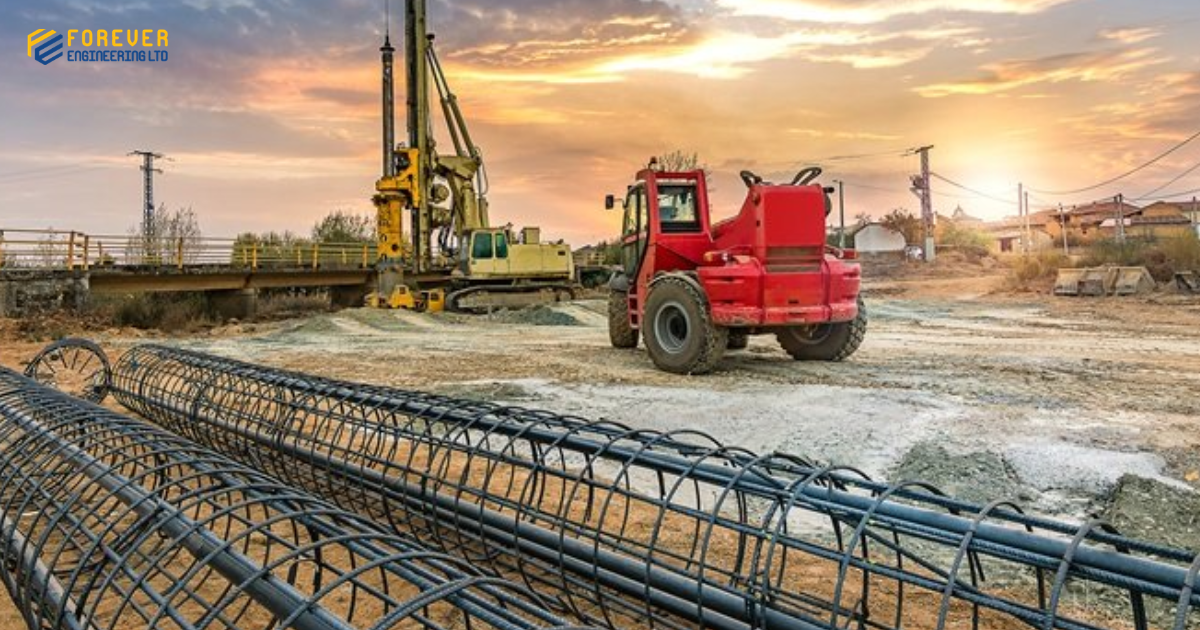
What Is the Cast in Situ Pile Construction Process?
The cast-in-situ pile construction process is a foundation construction method where workers drill a hole into the ground, place a reinforcement cage inside it, and pour concrete into the hole to form a strong reinforced concrete pile. The pile is built directly at the construction site instead of being manufactured in a factory.
This method is widely used in Bangladesh because many areas have soft soil. Buildings, bridges, factories, hospitals, and commercial structures need deep foundations to remain stable. Cast in situ piles transfer the building load from weak surface soil to stronger soil layers deep underground.
A properly constructed pile foundation improves the strength, safety, and lifespan of any structure. Every construction step must follow engineering standards to achieve the required load-bearing capacity and long-term performance.
In this guide, you will learn the complete cast-in-situ pile construction process step by step, the equipment used, quality control methods, safety measures, and the common mistakes to avoid.
Why Is the Cast in Situ Pile Construction Process Important?
A building is only as strong as its foundation. Even the best-designed building may develop cracks or settlement problems if the foundation is weak.
The cast in situ pile construction process creates a solid connection between the structure and the stable soil below the ground. This process helps the building carry heavy loads safely for many years.
Some major benefits include the following:
- High load-bearing capacity
- Better structural stability
- Reduced building settlement
- Long service life
- Suitable for soft soil
- Flexible pile depth
- Strong earthquake resistance
- Reliable performance for heavy structures
Because of these advantages, engineers choose cast in situ piles for many residential, commercial, and industrial projects across Bangladesh.

Step 1: Site Investigation and Soil Testing
The first step in the cast-in-situ pile construction process is site investigation.
Before starting any pile work, engineers perform a detailed soil investigation. They collect soil samples from different depths and test them in a laboratory.
The soil report provides important information about:
- Soil layers
- Soil strength
- Groundwater level
- Bearing capacity
- Recommended pile depth
- Suitable pile diameter
This information helps engineers design a safe and cost-effective foundation.
Without proper soil testing, the pile design may not meet the building’s load requirements.
Step 2: Pile Layout and Setting Out
After completing the soil investigation, engineers prepare the pile layout. They mark every pile position according to the approved structural drawing. Survey engineers use modern instruments to ensure accurate pile locations. Correct pile positioning is very important because even a small mistake can affect the foundation alignment and structural performance.
During this stage, engineers also verify:
- Pile spacing
- Pile center location
- Reference levels
- Construction boundaries
Proper setting out reduces construction errors later.
Step 3: Mobilization of Equipment
The next step is bringing construction equipment to the site.
The contractor installs all required machinery before starting pile work.
Common equipment includes:
- Rotary drilling rig
- Hydraulic piling rig
- Crane
- Concrete mixer
- Concrete pump
- Tremie pipe
- Bentonite mixing unit
- Welding machine
Before work begins, operators inspect every machine to ensure safe operation. Good equipment improves construction quality and reduces project delays.
Step 4: Drilling the Borehole
Drilling is one of the most important stages of the Cast in Situ Pile Construction Process. The drilling rig creates a vertical hole according to the required pile diameter and depth.
Engineers continuously monitor:
- Borehole depth
- Vertical alignment
- Diameter
- Soil condition
If groundwater enters the borehole, contractors may use bentonite slurry or temporary casing to prevent the hole from collapsing. The drilling continues until the pile reaches the required bearing layer. A properly drilled borehole ensures better pile performance.
Step 5: Cleaning the Borehole
After drilling reaches the required depth, workers clean the borehole. During drilling, loose soil, sand, and debris collect at the bottom. Workers remove these materials using cleaning buckets or airlifting methods. A clean borehole allows the concrete to bond properly with the surrounding soil. Poor cleaning may reduce pile strength and load capacity. Therefore, engineers carefully inspect the borehole before moving to the next stage.
Step 6: Fabrication of Reinforcement Cage
The reinforcement cage forms the steel framework inside the pile. Workers fabricate the cage according to the approved structural design.
The reinforcement usually includes:
- Longitudinal steel bars
- Spiral ties
- Circular rings
- Spacers
- Cover blocks
Every steel bar must meet the required diameter and spacing. Engineers inspect the reinforcement before installation to ensure it matches the approved drawing. Quality reinforcement improves the pile’s tensile strength and durability.
Step 7: Lowering the Reinforcement Cage
After inspection, workers carefully lower the reinforcement cage into the borehole. A crane lifts and positions the cage slowly to prevent bending or damage.
Workers ensure that:
- The cage remains vertical.
- The reinforcement reaches the full pile depth.
- Concrete cover remains uniform.
- The cage stays at the correct level.
Proper installation keeps the reinforcement centered inside the pile.
Step 8: Concrete Pouring Using Tremie Pipe
After the reinforcement cage is in place, workers begin pouring concrete into the borehole. This is one of the most important steps in the cast-in-situ pile construction process because the concrete forms the body of the pile. Workers usually use a tremie pipe to place concrete from the bottom of the borehole. This method prevents the concrete from mixing with water or soil. The tremie pipe remains inside the concrete during pouring, which helps create a continuous and uniform pile. The concrete must flow without interruption. If the pouring stops for a long time, cold joints may develop inside the pile. These weak points can reduce the pile’s strength. Engineers check the concrete quality before pouring. They test the slump to ensure the concrete has the right workability. They also verify that the concrete meets the required design strength. Proper concrete placement produces a dense, strong, and durable pile.
Step 9: Removing Temporary Casing
Some construction sites require temporary casing to support the borehole during drilling. Once workers pour enough concrete, they slowly remove the casing.
The casing must be pulled out carefully while maintaining continuous concrete flow. If workers remove it too quickly, the borehole may collapse or allow soil to enter the fresh concrete. Engineers monitor this process closely to maintain the pile’s shape and quality.
Step 10: Concrete Curing
Concrete needs time to gain strength after pouring. Curing is an important part of the Cast in Situ Pile Construction Process because it allows the concrete to harden properly. During curing, the concrete develops its designed compressive strength. Good curing also reduces cracks and improves durability.
Although most of the pile remains underground, the exposed pile head should receive proper curing until the concrete reaches sufficient strength. Proper curing increases the service life of the foundation.
Step 11: Pile Head Cutting
After the concrete gains enough strength, workers remove the weak concrete at the top of the pile. This process is called pile head cutting.
The upper portion may contain loose concrete, laitance, or impurities that formed during casting. Workers carefully chip away this layer until they reach sound concrete. After cutting, they expose the reinforcement bars for connection with the pile cap. A properly prepared pile head ensures a strong bond between the pile and the foundation structure.
Step 12: Pile Testing and Inspection
Pile testing confirms that the completed pile can safely support the design load. Engineers perform different tests depending on project requirements.
Common tests include:
- Static Load Test
- Dynamic Load Test
- Low Strain Integrity Test
- Cross Hole Sonic Logging
- Pile Integrity Test
These tests identify defects, verify pile quality, and confirm the load-bearing capacity. Testing gives engineers confidence that the foundation will perform safely throughout the building’s life.
Quality Control During the Cast in Situ Pile Construction Process
Quality control is essential at every stage of pile construction. Engineers inspect the work continuously to ensure the pile meets design requirements. Important quality checks include:
Soil Verification
Engineers compare the actual soil conditions with the soil investigation report.
Borehole Inspection
They measure:
- Borehole depth
- Diameter
- Vertical alignment
- Bottom cleanliness
Reinforcement Inspection
The reinforcement cage must match the approved drawing.
Engineers check:
- Steel diameter
- Bar spacing
- Cage length
- Welding quality
- Concrete cover
Concrete Testing
Workers perform several concrete tests, including:
- Slump test
- Cube compressive strength test
- Concrete temperature check
These tests ensure the concrete meets the required quality.
Final Inspection
After construction, engineers inspect the finished pile before starting pile cap construction. Good quality control reduces construction defects and improves foundation performance.
Safety Measures During Cast-in-Situ Pile Construction
Pile construction involves heavy machinery, deep excavation, and lifting operations. Safety should always be the first priority.
Important safety measures include:
- Wear helmets, gloves, boots, and reflective jackets.
- Inspect all lifting equipment before use.
- Keep unauthorized people away from the drilling area.
- Follow safe crane operating procedures.
- Secure electrical connections.
- Provide proper lighting for night work.
- Maintain clear communication between workers and machine operators.
- Follow emergency response procedures.
A safe construction site protects workers and prevents project delays.
Equipment Used in the Cast in Situ Pile Construction Process
Modern equipment improves construction speed and quality.
Common equipment includes:
- Rotary drilling rig
- Hydraulic piling rig
- Crane
- Concrete transit mixer
- Concrete pump
- Tremie pipe
- Bentonite plant
- Welding machine
- Excavator
- Survey equipment
Using well-maintained machinery helps complete the project efficiently and safely.

Factors That Affect the Construction Process
Several factors influence the cast-in-situ pile construction process.
Soil Condition
Soft or loose soil may require deeper piles or additional borehole support.
Groundwater Level
High groundwater levels require careful concrete placement and borehole protection.
Weather
Heavy rain can interrupt construction and affect concrete quality.
Equipment Performance
Modern equipment increases productivity and reduces delays.
Skilled Workers
Experienced workers improve workmanship and reduce construction errors.
Understanding these factors helps contractors complete projects more efficiently.
Common Mistakes During the Cast in Situ Pile Construction Process
Even a small mistake during pile construction can affect the strength and stability of the entire building. Contractors and engineers should carefully monitor every stage of the Cast in Situ Pile Construction Process to avoid problems.
Skipping Soil Investigation
Some project owners try to save money by skipping soil testing. This is a costly mistake. Without a proper soil investigation, engineers cannot determine the correct pile depth or diameter. A poor foundation design may lead to excessive settlement and structural damage.
Poor Borehole Cleaning
Loose soil and debris often collect at the bottom of the borehole after drilling. If workers do not clean the borehole properly, the concrete cannot bond well with the soil. This reduces the pile’s load-bearing capacity.
Incorrect Reinforcement Placement
The reinforcement cage must remain in the center of the borehole. If it touches the side of the hole or shifts during installation, the concrete cover becomes uneven. This may lead to steel corrosion and reduce the pile’s durability.
Interrupted Concrete Pouring
Concrete should be poured continuously without long delays. If workers stop the pouring process, cold joints may form inside the pile. These weak sections reduce the overall strength of the foundation.
Using Low-Quality Materials
Low-quality concrete or reinforcement steel can shorten the life of the foundation. Always use approved construction materials that meet engineering standards.
Poor Supervision
Every stage of pile construction requires proper supervision. Experienced engineers and site supervisors help identify problems before they become serious.
Advantages of Following the Proper Cast in Situ Pile Construction Process
A properly constructed pile foundation offers many long-term benefits for any building.
Some of the main advantages include:
- High load-bearing capacity
- Strong and stable foundation
- Better resistance to settlement
- Long service life
- Improved structural safety
- Suitable for soft soil conditions
- Flexible pile depth according to soil conditions
- Lower maintenance costs
- Better performance during earthquakes
- Reliable support for heavy buildings
Following the correct construction process also helps reduce future repair costs and increases the overall value of the property.
Why Choose Forever Engineering Ltd.?
At Forever Engineering Ltd., we provide professional Cast in Situ Pile Construction Process services for residential, commercial, and industrial projects across Bangladesh.
Our experienced engineers and skilled workers follow strict quality control procedures at every stage of construction. From soil investigation to final pile testing, we ensure every pile meets the required engineering standards. We use modern piling equipment, high-quality concrete, and certified reinforcement steel to deliver durable and reliable foundations.
Our services include:
- Soil investigation support
- Pile foundation design assistance
- Cast in situ pile construction
- Quality control and inspection
- Pile load testing
- Experienced engineering supervision
- Modern piling equipment
- On-time project completion
Our goal is to build safe, strong, and long-lasting foundations for every project.
Conclusion
The Cast-in-situ Pile Construction Process is one of the most reliable foundation methods for modern construction projects. It provides excellent strength, stability, and durability, especially in areas with soft soil like Bangladesh.
Every step plays an important role, from soil investigation and borehole drilling to reinforcement placement, concrete pouring, curing, and pile testing. Careful planning, skilled workers, quality materials, and proper supervision ensure that the pile foundation performs well throughout the life of the structure.
Whether you are building a house, apartment, factory, office building, hospital, or bridge, following the correct construction process helps create a strong foundation that supports the structure safely for many years.
Frequently Asked Questions
- What is the Cast-in-Situ Pile Construction Process?
The Cast-in-Situ Pile Construction Process is a method where workers drill a borehole, place a reinforcement cage inside it, and pour concrete to create a reinforced concrete pile directly at the construction site.
- Why is soil testing important before pile construction?
Soil testing helps engineers determine the correct pile depth, diameter, and load-bearing capacity. It ensures a safe and economical foundation design.
- How long does cast-in-situ pile construction take?
The construction time depends on the number of piles, pile depth, soil condition, and project size. Small projects may finish within a few days, while large projects may take several weeks.
- What equipment is used during pile construction?
Common equipment includes rotary drilling rigs, cranes, concrete pumps, tremie pipes, transit mixers, bentonite plants, welding machines, and survey instruments.