
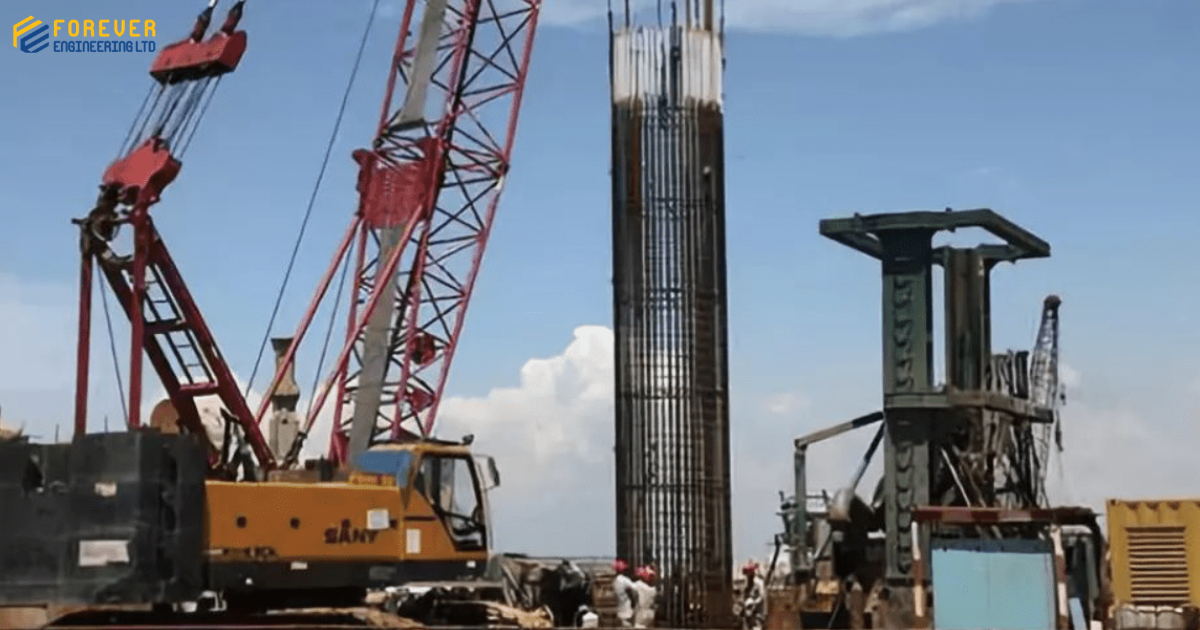
What Is Cast-in-Situ Pile Size?
“Cast in situ pile size” refers to the diameter and depth of a cast in situ pile that engineers design according to the building load and soil condition. Workers construct these piles directly at the project site by drilling a borehole, placing a steel reinforcement cage inside it, and pouring concrete into the hole. Once the concrete gains enough strength, it forms a strong foundation that supports the structure above.
In Bangladesh, many areas have soft clay and loose soil. Because of these soil conditions, engineers often use cast in situ piles for residential buildings, commercial buildings, factories, bridges, hospitals, and high-rise projects. Every project needs a different cast-in-situ pile size because every building has different loading requirements.
This guide explains everything you need to know about cast-in-situ pile size, including standard diameters, factors that affect pile selection, common applications, and why choosing the right size is important for a safe and durable foundation.

Why Is Cast-in-Situ Pile Size Important?
A building is only as strong as its foundation. Even the best-designed structure cannot perform well if the foundation is weak. That is why selecting the correct cast-in-situ pile size is an important part of every construction project. The pile transfers the building load from weak surface soil to stronger soil layers deep below the ground. When engineers choose the correct pile diameter and depth, the foundation performs safely throughout the life of the structure.
The right pile size also helps reduce uneven settlement. Settlement happens when the ground moves under the building. Excessive settlement can cause cracks in walls, uneven floors, damaged columns, and expensive repairs. A properly designed pile minimizes these risks and keeps the structure stable. Another reason why cast-in-situ pile size matters is construction cost. A larger pile requires more drilling, more concrete, and more reinforcement steel. These factors increase the project budget. On the other hand, using a smaller pile than required can create serious safety problems. Engineers balance safety and cost before finalizing the pile size.
Choosing the correct pile size provides many benefits.
- Higher load-bearing capacity
- Better structural stability
- Reduced settlement
- Longer foundation life
- Lower maintenance cost
- Improved safety
- Better performance in soft soil
- Cost-effective construction
Standard Cast in Situ Pile Sizes
There is no single pile size that fits every project. Engineers select the diameter according to the structural load and soil report. However, several standard sizes are commonly used in construction projects.
300 mm Cast in Situ Pile Size
A 300 mm pile is suitable for light residential buildings and small structures. Engineers use this size where soil conditions are good and building loads are relatively low.
400 mm Cast in Situ Pile Size
Many houses, duplex buildings, and small commercial buildings use a 400 mm pile. This size provides better strength while keeping construction costs reasonable.
500 mm Cast in Situ Pile Size
A 500 mm pile is one of the most common sizes for medium-rise buildings. It can support higher loads and performs well in many soil conditions found in Bangladesh.
600 mm Cast in Situ Pile Size
Commercial buildings, hospitals, educational institutions, and office buildings often require a 600 mm pile. This size provides greater load-bearing capacity and improved stability.
750 mm Cast in Situ Pile Size
Large industrial buildings and heavy commercial projects usually use a 750 mm pile. It can safely support heavy structural loads and large machinery.
800 mm to 1000 mm Cast-in-Situ Pile Size
High-rise buildings, bridges, flyovers, power plants, and other major infrastructure projects often require piles with diameters between 800 mm and 1000 mm or even larger. These piles carry extremely heavy loads and perform well under demanding conditions.
The final cast-in-situ pile size always depends on engineering calculations, soil investigation, and the structural design of the building.
Factors That Affect Cast in Situ Pile Size
Several important factors influence the selection of cast-in-situ pile size. Engineers carefully study each factor before they prepare the final foundation design.
Soil Condition
The soil condition is one of the most important factors. Soft clay, loose sand, and filled soil usually require larger or deeper piles because these soils cannot support heavy loads near the surface.
Strong soil layers allow engineers to use smaller pile diameters in some projects.
A detailed soil investigation helps engineers understand the soil profile and choose the most suitable pile size.
Building Load
The weight of the building directly affects the pile diameter. A single-story house produces much less load than a multi-story factory or commercial building.
Buildings with heavy machinery, storage equipment, or production lines often require larger cast-in-situ pile sizes to support the additional weight safely.
Groundwater Level
Groundwater can affect drilling and concrete placement during construction. Engineers consider groundwater conditions while selecting pile diameter and construction methods.
High groundwater levels often require careful planning to maintain borehole stability.
Structural Design
Every building has a unique structural design. The number of floors, column spacing, beam arrangement, and load distribution all influence the required pile size.
Structural engineers calculate these loads before recommending the final pile diameter.
How Engineers Calculate the Right Cast in Situ Pile Size
Choosing the right cast-in-situ pile size is not a matter of guesswork. Engineers follow a systematic process to ensure the foundation can support the building safely. Every project begins with detailed planning because the foundation affects the performance of the entire structure.
Soil Investigation
The first step is a soil investigation. Engineers drill boreholes at different locations on the site and collect soil samples from various depths. They send these samples to a laboratory for testing.
The soil report provides important information, including:
- Soil type
- Soil strength
- Groundwater level
- Bearing capacity
- Depth of strong soil layers
This report helps engineers determine the suitable cast-in-situ pile size for the project.
Structural Load Calculation
After the soil investigation, structural engineers calculate the total load that the building will transfer to the foundation.
The calculation includes:
- Dead load from the building structure
- Live load from people and furniture
- Machine loads for industrial buildings
- Wind load
- Earthquake load where required
The final load determines the number of piles and the required pile diameter.
Engineering Design
After reviewing the soil report and structural calculations, engineers prepare the pile foundation design.
They decide:
- Pile diameter
- Pile depth
- Reinforcement details
- Concrete strength
- Pile spacing
This design ensures that the selected Cast in Situ pile size provides both safety and cost efficiency.
Cast-in-situ Pile Size for Different Types of Buildings
Different buildings require different foundation systems. The required pile size changes according to the building’s weight and purpose.
Residential Buildings
Small residential buildings usually carry light loads. Engineers often use pile diameters between 300 mm and 400 mm, depending on the soil condition.
These piles provide enough strength for houses, duplexes, and small apartment buildings.
Apartment Buildings
Multi-story apartment buildings require stronger foundations.
Many apartment projects use 400 mm to 600 mm cast-in-situ pile sizes, depending on the number of floors and soil conditions.
Commercial Buildings
Shopping malls, office buildings, hotels, and hospitals produce higher structural loads.
These projects commonly require 500 mm to 750 mm diameter piles.
Industrial Buildings
Factories often contain heavy machinery, production equipment, storage systems, and cranes.
Because of these heavy loads, industrial projects usually require 600 mm to 1000 mm Cast in Situ Pile Size.
Bridges and Flyovers
Bridge foundations must support very high loads and constant traffic.
Engineers often use piles larger than 1000 mm for these major infrastructure projects.

Construction Process Based on Cast in Situ Pile Size
Although pile diameter changes from one project to another, the construction process remains almost the same.
Step 1: Site Preparation
Workers clear the construction site before piling begins.
Survey engineers mark the exact pile locations according to the approved structural drawings.
Accurate positioning ensures proper load distribution.
Step 2: Borehole Drilling
Workers drill a borehole using a rotary drilling rig.
The drilling diameter matches the approved Cast in Situ pile size.
Engineers continuously check:
- Borehole depth
- Vertical alignment
- Diameter
- Soil condition
Proper drilling creates the correct shape for the pile.
Step 3: Borehole Cleaning
Loose soil, sand, and debris collect at the bottom of the borehole during drilling.
Workers remove these materials before placing reinforcement.
A clean borehole improves the bond between concrete and soil.
Step 4: Reinforcement Cage Installation
Workers fabricate the reinforcement cage according to the approved drawings.
A crane carefully lowers the cage into the borehole.
The cage must remain in the center to maintain the required concrete cover.
Step 5: Concrete Pouring
Workers pour concrete using a tremie pipe.
The concrete flows from the bottom upward and fills the entire borehole. Continuous pouring prevents weak joints inside the pile. Proper concrete placement ensures that the designed Cast in Situ Pile Size achieves its full strength.
Step 6: Curing
Concrete needs time to gain strength.
Proper curing improves durability and helps the pile reach its design strength.
Step 7: Pile Testing
After construction, engineers test the completed piles.
Common tests include:
- Static Load Test
- Dynamic Load Test
- Pile Integrity Test
- Low Strain Test
Testing confirms that the selected Cast in Situ Pile Size can safely support the building.
Quality Control During Cast in Situ Pile Construction
Quality control plays an important role throughout the construction process.
Engineers inspect every stage carefully.
Important quality checks include:
- Soil verification
- Borehole depth
- Borehole diameter
- Vertical alignment
- Reinforcement cage inspection
- Concrete slump test
- Concrete compressive strength
- Pile head inspection
Regular inspection reduces construction defects and improves long-term performance.
Common Mistakes When Choosing Cast in Situ Pile Size
Even a small mistake during foundation design can affect the entire building.
Some common mistakes include:
Skipping Soil Investigation
Without a soil report, engineers cannot determine the correct pile diameter or depth.
This may result in an unsafe foundation.
Selecting the Wrong Pile Diameter
Choosing a pile that is too small reduces load-bearing capacity.
Choosing an oversized pile increases project cost.
Poor Concrete Quality
Low-quality concrete reduces the strength and durability of the pile.
Incorrect Reinforcement Placement
The reinforcement cage must remain in the center of the borehole.
Improper placement reduces concrete cover and increases the risk of corrosion.
Poor Construction Supervision
Experienced engineers should supervise every stage of pile construction.
Good supervision prevents costly mistakes.
Advantages of Choosing the Right Cast in Situ Pile Size
Selecting the proper cast-in-situ pile size provides many long-term benefits.
Some of the main advantages include:
- High load-bearing capacity
- Better structural stability
- Longer service life
- Improved safety
- Reduced settlement
- Better earthquake resistance
- Lower maintenance costs
- Cost-effective foundation design
- Reliable performance in soft soil
- Strong support for heavy buildings
The right pile size protects the building and reduces future repair expenses.
Why Choose Forever Engineering Ltd.?
Choosing the right piling contractor is just as important as choosing the right cast-in-situ pile size. A well-designed foundation needs skilled engineers, quality materials, and proper supervision to perform well over the long term.
At Forever Engineering Ltd., we provide professional cast in situ piling services for residential, commercial, industrial, and infrastructure projects across Bangladesh. Our experienced engineering team follows approved construction methods and strict quality control at every stage of the project.
We understand that every site is different. Before starting construction, we carefully study the soil report, structural drawings, and project requirements. This allows us to recommend the most suitable cast-in-situ pile size for each building.
Our team focuses on safety, quality, and timely project completion. We use modern piling equipment and high-quality construction materials to build strong and durable foundations.
Our services include:
- Soil investigation support
- Foundation design assistance
- Cast in situ pile construction
- Reinforcement fabrication
- Concrete quality control
- Pile integrity testing
- Static load testing
- Engineering supervision
- Modern piling equipment
- On-time project completion
Our goal is to provide every client with a safe foundation that supports their investment for many years.
Conclusion
Selecting the correct cast-in-situ pile size is one of the most important decisions during foundation construction. The pile diameter and depth directly affect the strength, stability, and durability of the building. A properly designed pile foundation safely transfers structural loads to strong soil layers below the ground and reduces the risk of settlement.
There is no standard pile size that works for every project. Engineers determine the right cast-in-situ pile size after studying the soil condition, groundwater level, structural load, and building type. This process helps create a safe and cost-effective foundation without using unnecessary materials.
Whether you are building a house, apartment, commercial complex, factory, warehouse, hospital, or bridge, choosing the correct cast-in-situ pile size will improve structural performance and extend the life of your building.
Working with an experienced piling contractor also makes a big difference. Skilled engineers, quality materials, and proper construction methods ensure that every pile performs as designed. A strong foundation not only protects the building but also reduces future maintenance costs and gives you peace of mind. If you are planning a new construction project in Bangladesh, Forever Engineering Ltd. is ready to deliver reliable cast-in-situ piling solutions that meet modern engineering standards and support your project from the ground up.
Frequently Asked Questions
- What is the cast-in-situ pile size?
“Cast in situ pile size” refers to the diameter and depth of a cast in situ pile. Engineers choose the size based on the soil condition, building load, and structural design.
- What is the standard cast-in-situ pile size?
Common pile diameters range from 300 mm to 1000 mm. The final size depends on the project’s engineering requirements.
- How do engineers select the correct cast-in-situ pile size?
Engineers review the soil investigation report, calculate the building load, check groundwater conditions, and follow structural drawings before selecting the pile size.
- Which Cast-in-Situ Pile Size is suitable for industrial buildings?
Industrial buildings often require 600 mm to 1000 mm diameter piles because they carry heavy machinery and equipment. However, the exact size depends on the design calculations.
- Does a larger cast-in-situ pile size always mean a stronger foundation?
Not always. A larger pile can carry more load, but engineers choose the pile size based on the project’s actual requirements. Using a pile that is larger than necessary can increase construction costs without adding useful benefits.
- Why is soil testing important before selecting cast-in-situ pile size?
Soil testing helps engineers understand the soil strength, groundwater level, and bearing capacity. This information is essential for selecting a safe and economical pile size.
- Can the same Cast-in-Situ pile size be used for every project?
No. Every building has different loading conditions and soil characteristics. Engineers design the pile size specifically for each project.
- Why should I choose Forever Engineering Ltd. for cast in situ piling?
Forever Engineering Ltd. offers experienced engineers, modern piling equipment, strict quality control, professional supervision, and reliable foundation solutions for residential, commercial, and industrial projects throughout Bangladesh.